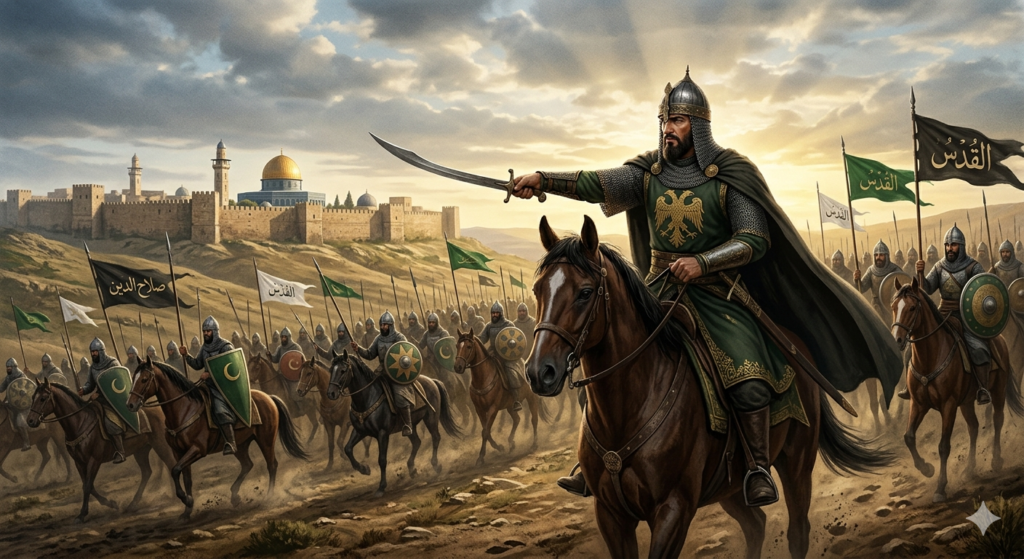
Sultan Salahuddin Ayubi: The Great Liberator of History
The name of Sultan Salahuddin Ayubi (known in the West as Saladin) shines in Islamic history like a star whose brilliance influenced not only Muslims but people across the globe. He was a magnificent military commander, a private ascetic, a just ruler, and the liberator of Jerusalem. His character remains the ultimate personification of the “Chivalrous Knight” in both Eastern and Western traditions.
1. Early Life and Background
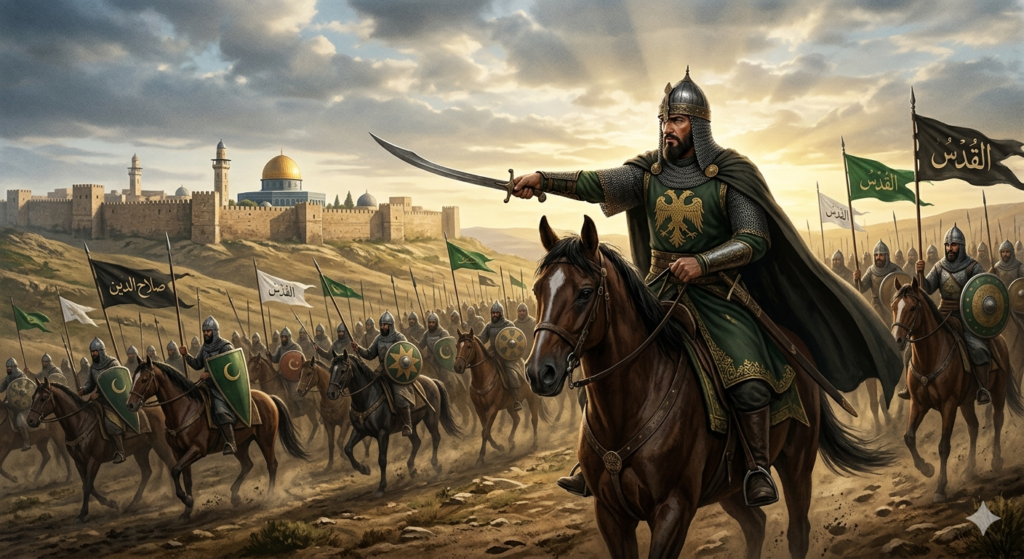
Salahuddin was born in 1137 (or 1138) AD in the city of Tikrit, Iraq. His birth name was Yusuf ibn Najmuddin Ayyub. He belonged to a noble Kurdish family. His father, Najmuddin Ayyub, and his uncle, Asaduddin Shirkoh, were prominent military leaders under the famous ruler Sultan Imaduddin Zangi.
Salahuddin spent his youth in Damascus, which was the center of Islamic learning at the time. He did not initially set out to be a warrior; he was deeply devoted to religious studies, philosophy, and history. It is said that in his youth, he preferred the company of scholars over the barracks, but destiny led him to the battlefield to fulfill a greater purpose.
2. The Conquest of Egypt and the Ayyubid Dynasty
Salahuddin’s political journey began when he accompanied his uncle, Shirkoh, on military expeditions to Egypt. At that time, the Fatimid Caliphate in Egypt was weakening, and the Crusaders were plotting to seize it.
- Rise to Power: After his uncle’s death, Salahuddin was appointed as the Vizier of Egypt.
- Islamic Unity: He quickly restored order in Egypt and abolished the Fatimid Caliphate, re-establishing a connection with the Abbasid Caliphate in Baghdad.
- The Sultanate: Following the death of his mentor, Sultan Nuruddin Zangi, Salahuddin united Egypt, Syria, Hijaz, and Yemen under one banner, founding the Ayyubid Dynasty.
3. The Battle of Hattin: A Decisive Victory
Salahuddin’s life mission was to liberate Bait-ul-Muqaddas (Jerusalem) from the Crusaders, who had occupied it for nearly 90 years.
On July 4, 1187, the historic Battle of Hattin took place. Through brilliant military strategy, Salahuddin lured the Crusader army into a waterless volcanic plain during the scorching heat. The Crusader forces were decisively defeated, and their top leaders, including the King of Jerusalem, were captured. This victory paved the clear path for the liberation of the Holy City.
4. The Conquest of Jerusalem: A Lesson in Mercy
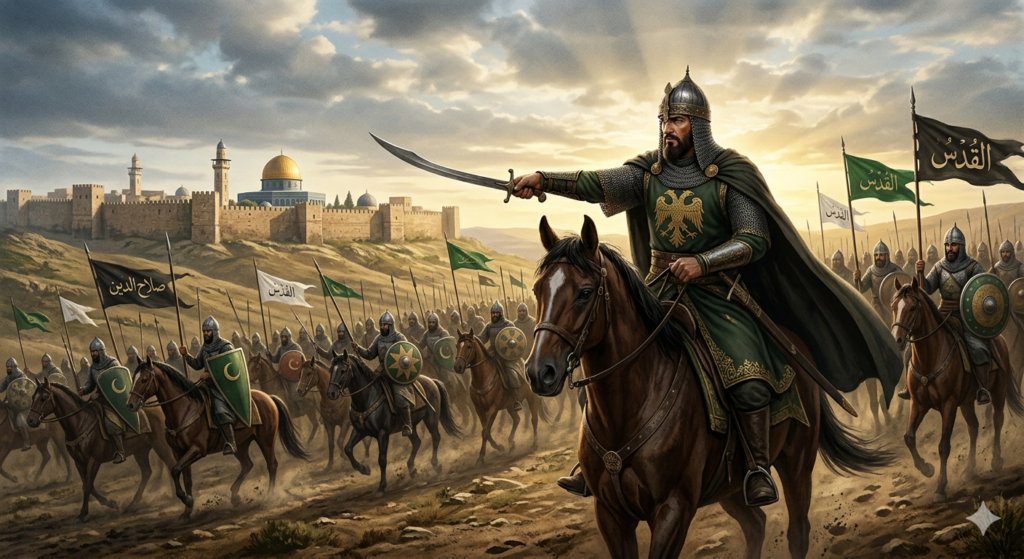
On October 2, 1187, Sultan Salahuddin entered Jerusalem as a conqueror. This day became a landmark in history because of how the Sultan handled the victory. Unlike the Crusaders, who had filled the streets with blood when they captured the city in 1099, Salahuddin chose mercy and justice.
The Historical Contrast: > * He strictly forbade any massacre or looting.
- He granted amnesty to the Christians and allowed them to leave with their property.
- For those who were too poor to pay their own ransom, the Sultan and his brother paid it out of their own personal wealth.
5. The Third Crusade and Richard the Lionheart
The fall of Jerusalem shocked Europe, leading to the Third Crusade, led by King Richard I of England (Richard the Lionheart).
Despite being fierce enemies on the battlefield, the mutual respect between Salahuddin and Richard became legendary.
- When Richard fell ill with fever, Salahuddin sent him fresh fruits and mountain ice.
- When Richard’s horse was killed in battle, the Sultan sent him two noble Arabian steeds, stating that a king should not fight on foot.
Eventually, in 1192, the Treaty of Jaffa was signed. Jerusalem remained under Muslim control, but the Sultan guaranteed that unarmed Christian pilgrims could visit the city freely to perform their prayers.
6. Character and Personality
Salahuddin was not just a conqueror; he was a man of immense piety and simplicity.
- Asceticism: Despite ruling a vast empire, he lived a very simple life and never indulged in the luxuries of the palace.
- Generosity: He was so charitable that at the time of his death, his treasury was empty. He gave away everything to the poor and for the defense of the state.
- Justice: He believed in the rule of law. History records instances where he appeared in court like an ordinary citizen to answer a lawsuit filed against him.
7. Death and Legacy
Sultan Salahuddin Ayubi passed away in Damascus on March 4, 1193. It is a poignant fact of history that when he died, he did not have enough money in his personal account to pay for his own funeral. He had spent his entire life and wealth for his people and the cause of Islam.
His Eternal Legacy:
- Unity: He united a fractured Muslim world during its most vulnerable time.
- Ethics in War: He proved that war could be fought with chivalry, honor, and compassion.
- The Liberator: He returned Jerusalem to the Muslim fold, a legacy that defines his name to this day.
Conclusion
Sultan Salahuddin Ayubi remains one of the few figures in history praised by both Muslim and Christian historians. He conquered hearts more than he conquered lands. His life teaches us that true success is not found in power or wealth, but in faith, patience, and the highest standards of moral character.
May Allah elevate the ranks of Sultan Salahuddin Ayubi. (Ameen)