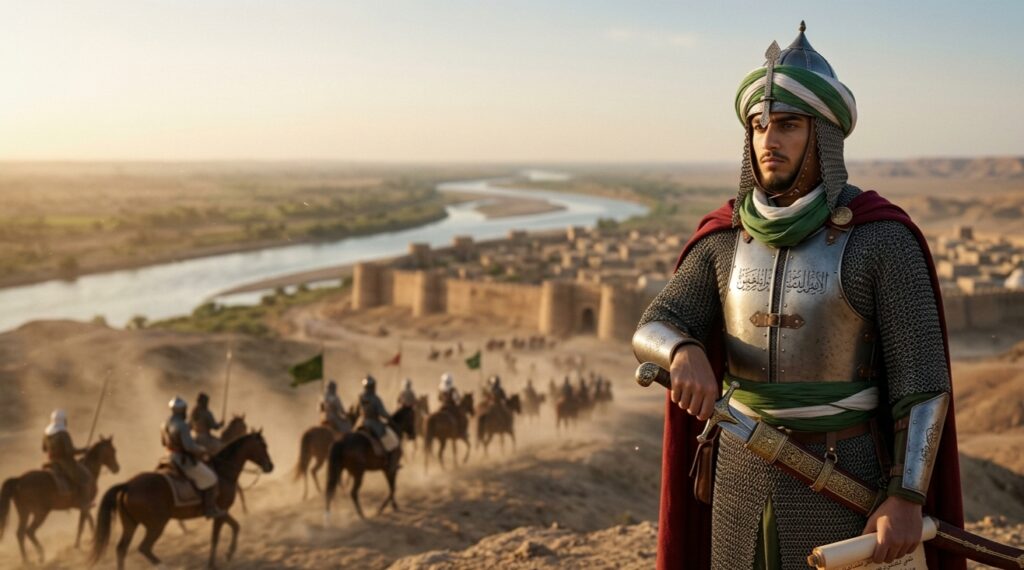
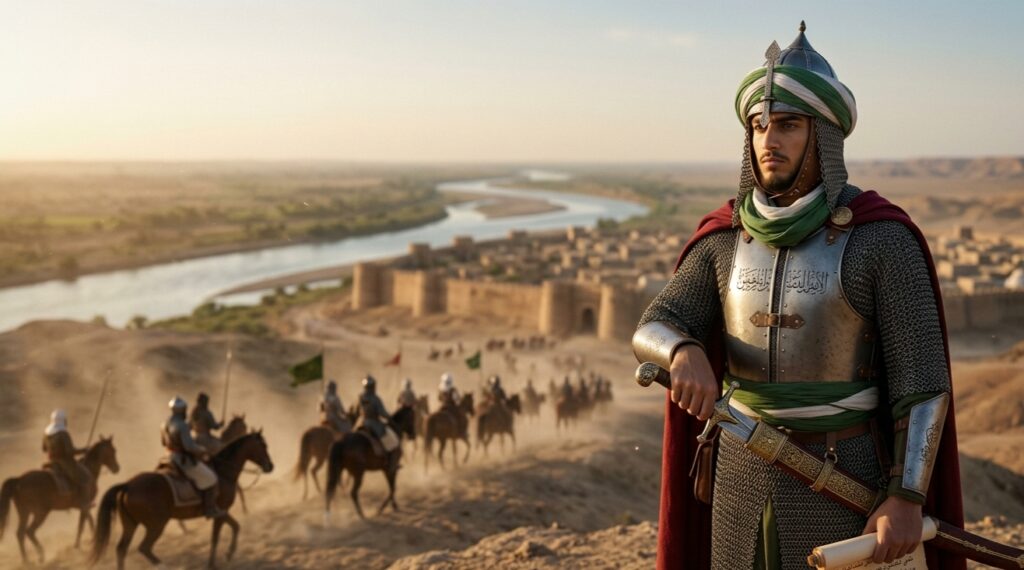
The story of Muhammad bin Qasim is not just a tale of military conquest; it is the chronicle of a young visionary who bridged two civilizations. Below is a detailed account of his life, his journey to the Indus, and his lasting legacy.The Conqueror of Sindh: The Saga of Muhammad bin QasimThe Dawn of a Young LeaderMuhammad bin Qasim Al-Thaqafi was born around 695 AD in the city of Taif, in modern-day Saudi Arabia. His father, Qasim bin Yusuf, passed away when Muhammad was still a child, leaving his upbringing to his mother and his powerful paternal uncle, Hajjaj bin Yusuf, the Governor of Iraq.Even as a teenager, Muhammad displayed an intellect that far outpaced his peers. Under Hajjaj’s tutelage, he was trained in both the art of governance and the science of warfare. At the age of 15, he was already leading successful military expeditions in Persia (Iran), earning a reputation for his strategic brilliance and calm temperament under pressure.The Catalyst for WarThe history of South Asia changed because of a single act of piracy. In the early 8th century, the King of Sarandip (modern-day Sri Lanka) sent eight ships filled with gifts, orphaned Muslim girls, and pilgrims as a gesture of goodwill to the Umayyad Caliphate.As the ships neared the coast of Debal (near modern-day Karachi), they were attacked and looted by sea pirates. The women and children were taken captive. When word reached Hajjaj bin Yusuf, he sent a letter to Raja Dahir, the powerful ruler of Sindh, demanding the release of the captives and the punishment of the pirates. Dahir’s dismissive reply—claiming he had no control over the pirates—provided the casus belli for one of the most significant expeditions in Islamic history.The Campaign of Sindh (712 AD)In 711 AD, Hajjaj appointed the 17-year-old Muhammad bin Qasim to lead an army of 6,000 elite Syrian cavalrymen toward the Indus. This was not merely a mission of revenge; it was a sophisticated military operation.The Siege of Debal: Muhammad bin Qasim arrived at the port of Debal with heavy siege engines, including a massive catapult named “Al-Aroos” (The Bride). The city was protected by high walls and a sacred red flag flying atop a great temple. Muhammad realized that the flag served as a symbol of morale. He directed his catapults to strike the flagstaff. When the flag fell, the defenders panicked, and the city was captured.The Battle of Rawar: After capturing several key cities like Nerun and Sehwan, the final showdown occurred at Rawar. Raja Dahir met the Muslim army with a massive force, including war elephants that looked like moving fortresses. However, Muhammad used fire-arrows to scare the elephants, causing them to retreat into their own ranks. Raja Dahir was killed in the heat of the battle, marking the end of his dynasty.Governance Beyond the SwordWhat set Muhammad bin Qasim apart from other conquerors was his policy of tolerance. He did not force conversions. Instead, he treated the local Hindus and Buddhists as “Dhimmis” (protected citizens).He allowed the locals to rebuild their temples and maintain their traditions. He even appointed local Brahmins to high-ranking administrative positions, recognizing their experience in local governance. The common people of Sindh, who had been marginalized under the previous caste-based hierarchy, saw him not as an invader, but as a liberator. It is said that when he eventually left a city, the local population would weep in grief.A Tragic EndThe glory of Muhammad bin Qasim was short-lived. A shift in power occurred in Damascus; Caliph Walid I died and was succeeded by Sulaiman bin Abdul Malik. Sulaiman held a deep personal grudge against Hajjaj bin Yusuf (who had recently passed away) and targeted all of Hajjaj’s relatives.Muhammad bin Qasim, at the height of his success, was summoned back in chains. Despite having a loyal army that would have fought for him, he chose the path of discipline and surrendered to the Caliph’s messengers. He was taken to Iraq, where he was imprisoned and tortured to death at the young age of 20.The Quality of His Character: JusticeIf one had to define Muhammad bin Qasim with a single quality, it would be Insaaf (Justice).His military genius brought him to Sindh, but his justice allowed him to stay in the hearts of the people. He proved that true leadership is not about the length of one’s life, but the depth of one’s impact. By establishing the “Bab-ul-Islam” (The Gateway of Islam), he laid the foundation for a spiritual and cultural transformation in the Indian subcontinent that lasts to this day.High-Quality Cinematic Image Description”A breathtaking cinematic 8K shot of Muhammad bin Qasim, a 17-year-old general with a sharp, determined gaze. He is wearing silver-trimmed white robes and light leather armor, standing atop a cliff overlooking the Indus River. The golden sun reflects off his unsheathed Damascus steel sword. In the background, his disciplined cavalry is seen through a haze of desert dust, with ancient flags fluttering in the wind. The style is hyper-realistic, capturing the heat of the desert and the epic scale of history.”