Introduction: The New Industrial Frontier
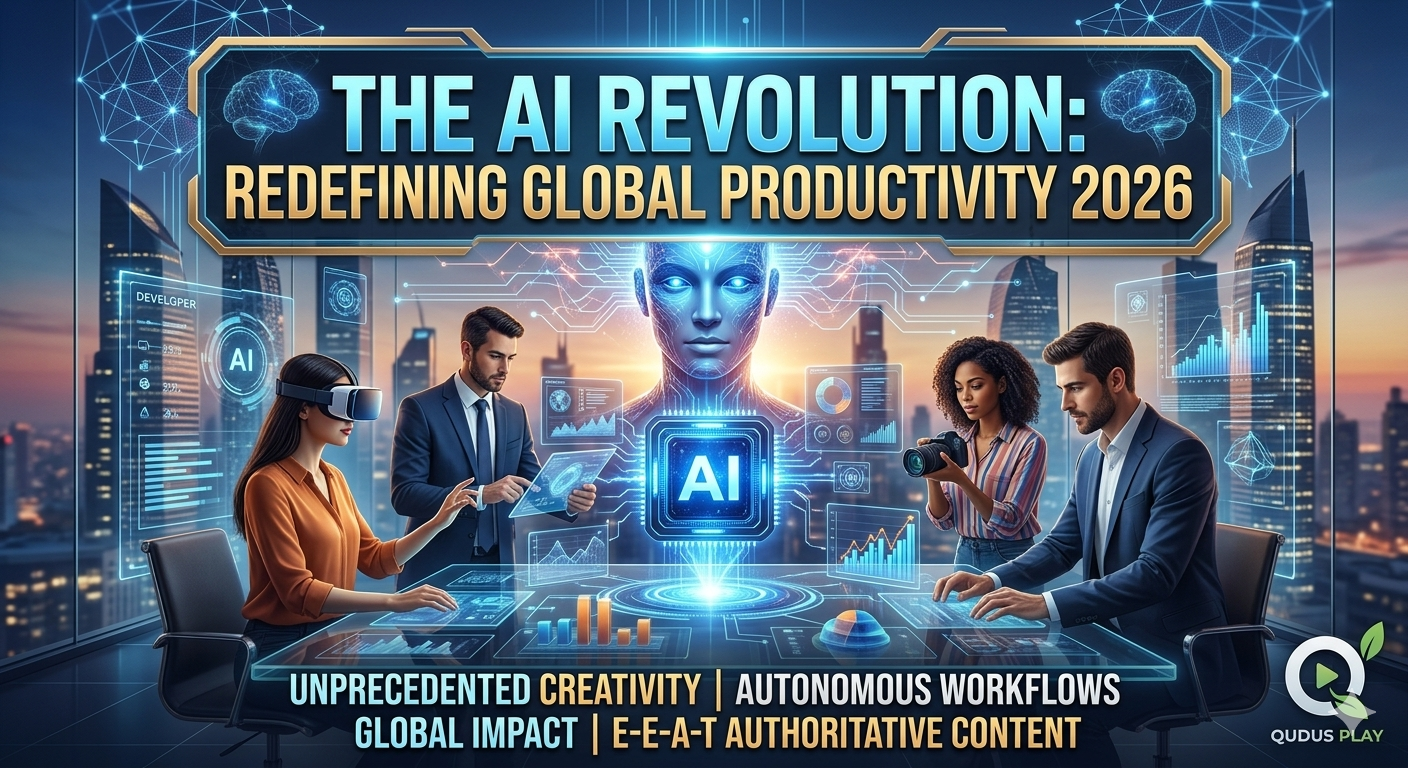
In the rapidly evolving digital landscape of 2026, Artificial Intelligence (AI) is no longer just a futuristic concept or a niche tool for tech enthusiasts—it is the primary engine driving the global economy. We are currently witnessing a shift more profound than the Industrial Revolution. This is the era of “Cognitive Automation,” where the focus has moved from physical labor to the optimization of intelligence.
For digital creators, business leaders, and remote workers, AI has transitioned from a “luxury” to a “mechanical necessity.” To compete in today’s market, understanding AI is not enough; one must master the art of AI orchestration. This comprehensive guide explores how AI is reshaping productivity, the essential tools of 2026, and the strategies required to thrive in an AI-augmented world.
1. The Dawn of the AI-First Era
The shift toward an AI-first world has been swifter than any previous technological transition. In 2026, productivity is no longer measured by the number of hours spent at a desk, but by the efficiency of one’s “AI stack.”
Whether you are a software developer in Silicon Valley, a webmaster in Pakistan managing niche sites, or a financial consultant in London, AI serves as the common denominator. It has leveled the playing field, allowing a single individual to perform tasks that previously required entire departments. The “Solopreneur” movement is at its peak, powered entirely by autonomous AI agents that handle everything from coding to customer support.
2. Transforming Workflows with Generative AI
Generative AI models, such as Gemini 3 Flash, GPT-5, and Claude 4, have moved beyond simple text-based interactions. The current generation of AI is characterized by:
A. Multimodal Execution
Modern AI can process and generate text, high-fidelity images, professional-grade video, and complex code simultaneously. For a webmaster, this means an AI can take a rough idea, generate a 2,000-word SEO-optimized article, create custom illustrations for it, and then produce a 30-second social media teaser video—all within minutes.
B. Autonomous Problem Solving
We have moved from “Chatbots” to “Agentic AI.” These are systems that don’t just answer questions but execute multi-step plans. For instance, you can instruct an AI agent to “Research the top 10 trending topics in the real estate niche, draft articles for each, and schedule them on my WordPress site.” The AI understands the context, performs the research, and executes the task without constant human intervention.
C. Hyper-Personalization at Scale
In 2026, marketing is no longer about broad demographics. AI analyzes real-time user behavior to create personalized content. This ensures that every visitor to a website sees a version of the content that is most relevant to their specific interests, significantly boosting conversion rates and AdSense revenue.
3. The Economic Impact: A Global Perspective
The integration of AI into the global workforce is projected to add over $15 trillion to the global GDP by the end of this decade.
- In Developing Economies: In countries like Pakistan, India, and Brazil, AI is acting as a massive “Skill Leveler.” It allows freelancers to bypass traditional educational barriers and offer high-end services like data science, architectural visualization, and advanced SEO to international clients.
- In Developed Economies: Developed nations are using AI to solve critical labor shortages. In sectors like healthcare and legal services, AI-driven diagnostics and research are allowing professionals to focus on high-stakes decision-making while automation handles the data-heavy drudgery.
4. Top AI Productivity Tools for 2026
To maximize output in this new era, professionals must utilize a specialized toolkit. Here are the leading categories:
I. Advanced Virtual Assistants
Gone are the days of simple voice commands. Modern assistants like Gemini Live provide real-time, natural voice conversations. They can share your screen, analyze complex spreadsheets, and even provide emotional coaching for high-pressure meetings.
II. Intelligent Project Management
Platforms like Notion AI and Monday.com now feature “Predictive Analytics.” They don’t just track tasks; they predict project bottlenecks. If a content writer is falling behind, the AI automatically suggests a resource reallocation or generates a draft to help the writer catch up.
III. The Creative Suite
For digital media production:
- Visuals: Midjourney v7 and Nano Banana 2 allow for photorealistic image generation with perfect text rendering.
- Video: Google’s Veo model generates 4K cinematic videos from text prompts, complete with natively generated audio.
- Coding: GitHub Copilot X now handles entire system architectures, allowing developers to build complex web applications in a fraction of the time.
5. Overcoming the “Blank Page” Syndrome
One of the greatest enemies of productivity is the “start.” AI has effectively eliminated this hurdle. By providing instant outlines, research summaries, and initial drafts, AI acts as a “Co-Pilot.”
Statistically, professionals using AI co-pilots report a 60-70% reduction in time spent on administrative tasks. This “Time Dividend” can be reinvested into creative strategy, relationship building, or personal well-being—leading to a more balanced and productive life.
6. SEO and Content Strategy in the AI Age
For website owners and SEO specialists, the rules of the game have changed. Google’s algorithms in 2026 are highly sophisticated.
- The Rise of E-E-A-T: (Experience, Expertise, Authoritativeness, and Trustworthiness). Google can now distinguish between “lazy” AI-generated filler and “high-value” AI-augmented content. To rank, your articles must provide unique insights that a machine cannot guess.
- Zero-Click Searches: With AI providing direct answers in search results, webmasters must focus on “Deep-Dive” content that encourages users to click through for more comprehensive information.
- Semantic Search: Keywords are less important than “User Intent.” Your content must answer the why and how behind a query, not just the what.
7. Ethics, Privacy, and the Human Element
As AI becomes more integrated into our lives, ethical considerations are paramount.
- Data Privacy: With AI processing vast amounts of personal data, the need for secure, “Zero-Knowledge” AI systems is rising.
- The Human Touch: Despite the power of AI, human qualities like empathy, critical thinking, and ethical judgment remain irreplaceable. The most successful people in 2026 are those who use AI to handle the “logic” while they provide the “soul” and “direction.”
8. Preparing for the Future: AI Literacy
The digital divide of 2026 is no longer about access to the internet; it is about AI Literacy. Learning how to “Prompt Engineer” and manage AI workflows is as essential as basic literacy was in the 20th century. Continuous learning is the only way to stay relevant as models update and new capabilities emerge.
Conclusion: Embracing the Synergy
The AI revolution is not a threat to human ingenuity; it is a celebration of it. We have built tools that can process the sum of human knowledge in seconds, giving us the freedom to explore new horizons.
By embracing AI as a partner in productivity, we are not just working faster—we are working smarter. We are entering an era of unprecedented human potential where the only limit is our imagination. Whether you are building a global brand or managing a niche blog like Qudus Play, the power to define the future is now at your fingertips, powered by Artificial Intelligence.