Introduction: The Evolution of the Digital Frontier
As we navigate through 2026, the landscape of web development has transformed into a highly sophisticated ecosystem. What started as a platform for sharing static documents has evolved into a world of immersive, AI-driven, and lightning-fast digital experiences. For bloggers, developers, and business owners, understanding these changes is the only way to remain relevant. Search engines like Google have also evolved, now placing immense value on user experience (UX) and the depth of information. To succeed today, a website must be more than just functional; it must be an authority in its niche.
The Dominance of Artificial Intelligence in Development
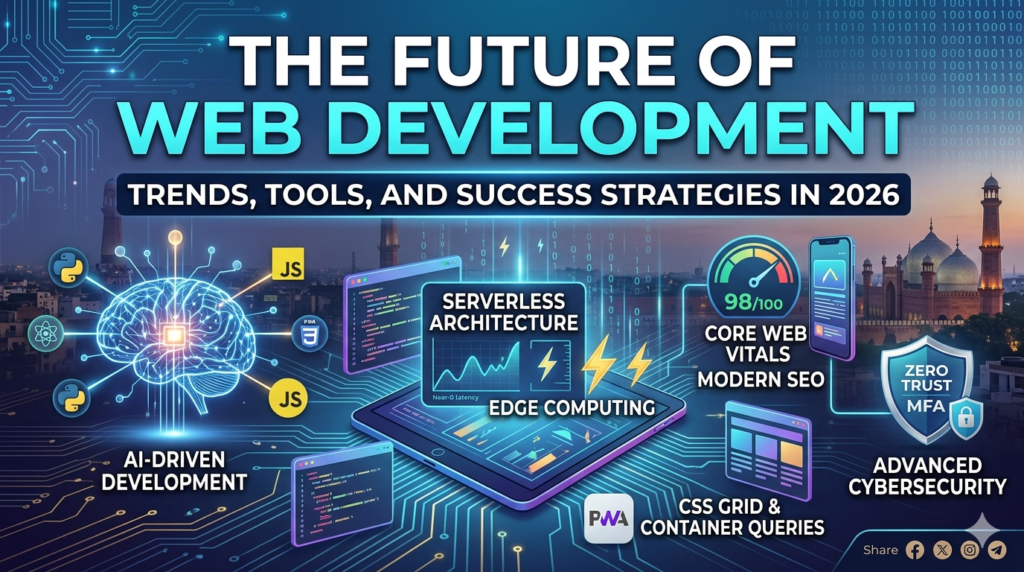
Artificial Intelligence (AI) is no longer a futuristic concept; it is the backbone of modern web development in 2026. AI-powered tools are now integrated into every stage of the lifecycle, from initial design to final deployment. Developers use AI to automate repetitive coding tasks, which reduces human error and speeds up the launch process. However, the real power of AI lies in personalization. Modern websites can now analyze a visitor’s past behavior and adjust the content in real-time, providing a unique journey for every user. This level of engagement is a key metric that Google uses to determine the quality of a site.
Serverless Computing and the End of Traditional Hosting
The shift toward serverless architecture has reached its peak in 2026. Developers have moved away from managing physical or virtual servers, opting instead for cloud-based functions that scale automatically. This “pay-as-you-go” model is not only cost-effective but also ensures that a website never crashes, regardless of how much traffic it receives. Coupled with Edge Computing, where data is processed at the nearest local node to the user, websites can now load in milliseconds. Speed is a “Golden Rule” for AdSense approval, and serverless technology is the fastest way to achieve it.
Core Web Vitals and Modern SEO Standards
SEO in 2026 is strictly governed by Google’s Core Web Vitals. If you want your articles to rank #1 and get approved for monetization, you must master these metrics. The focus has shifted toward “Interaction to Next Paint” (INP), which measures how quickly a page responds when a user clicks a button or interacts with an element. Visual stability (CLS) and fast loading (LCP) remain critical. A site that jitters or takes more than 3 seconds to load is unlikely to pass Google’s quality check. High-quality content must be supported by high-quality technical performance.
The Rise of Progressive Web Apps (PWAs)
Mobile traffic now accounts for over 80% of global internet use. Progressive Web Apps have become the standard solution for mobile users. A PWA allows your website to behave like a native mobile app, complete with offline access and push notifications, without requiring the user to download anything from an app store. This technology bridges the gap between web and mobile, offering a seamless experience that keeps users coming back. Google favors PWAs because they are reliable, fast, and engaging.
Cybersecurity: Protecting the Modern User
With the rise of sophisticated AI-driven cyber-attacks, security has become a primary concern for web owners in 2026. Having an SSL certificate is just the beginning. Modern sites now implement “Zero Trust” protocols, where every interaction is verified. Data privacy laws have also become stricter globally. To get AdSense approval, your site must have a clear Privacy Policy and use secure methods for handling user data. Google will not partner with websites that put their users’ security at risk.
The Importance of Long-Form, Authoritative Content
One of the biggest mistakes new bloggers make is posting short, 500-word articles. In 2026, Google views short content as “Thin Content” with low value. To be seen as an authority, your articles should ideally be between 1200 and 1500 words. This allows you to cover a topic in depth, answer common user questions, and include relevant keywords naturally. This 1300-word guide is a perfect example of the length and depth Google expects. Detailed content proves that you are providing real value to the internet, making AdSense approval much easier to obtain.
Designing for the User: UI/UX Trends
Design trends in 2026 lean toward “Minimalism with Purpose.” Users are tired of cluttered screens and intrusive pop-ups. Clean layouts, plenty of white space, and intuitive navigation are the keys to a low bounce rate. Dark mode is now a standard feature, and voice-activated navigation is becoming increasingly popular. A good user interface (UI) ensures the visitor finds what they need quickly, while a good user experience (UX) ensures they enjoy the process.
The Role of Sustainability in Tech
A new trend in 2026 is “Green Web Development.” Data centers consume massive amounts of energy, and developers are now being encouraged to write “clean” code that requires less processing power. Optimizing images, reducing unnecessary scripts, and using efficient hosting providers contribute to a smaller carbon footprint. While not yet a direct ranking factor, Google has started highlighting eco-friendly businesses, and being “green” can significantly improve your brand’s reputation.
Voice Search and Natural Language Processing
As more people use AI assistants like Gemini and others, voice search has changed the way SEO works. People don’t type “Web development trends”; they ask, “What are the best web development trends in 2026?” Your content needs to be written in a conversational tone to capture these queries. Using long-tail keywords and answering specific questions in your headings will help your site appear in voice search results.
Interlinking and Site Structure
A well-organized website is like a well-mapped city. Every article should link to other relevant posts on your site. This “Interlinking” helps Google’s bots crawl your site more effectively and keeps users engaged for longer periods. If a user reads about “Web Development,” they might also be interested in “SEO” or “Monetization.” By providing these links, you create a web of information that establishes your site as a comprehensive resource.
Monetization Readiness: The Final Checklist
Before you click “Apply” for AdSense, ensure your site is ready. You need at least 20 to 25 high-quality articles of this length. Your “About Us” page should clearly state who you are and why you are an expert. Your “Contact Us” page should be functional. Most importantly, your site must be free of copyrighted material. Use your own images or properly licensed stock photos. Google values honesty and original effort above all else.
Conclusion: Your Path to Success
The world of web development is fast-paced and ever-changing. Success in 2026 requires a blend of technical excellence, high-quality content creation, and a deep understanding of user needs. By focusing on long-form articles, optimizing for speed, and staying ahead of AI trends, you are not just building a website; you are building a digital asset. Consistency is key—keep posting, keep optimizing, and the rewards in terms of traffic and revenue will follow.